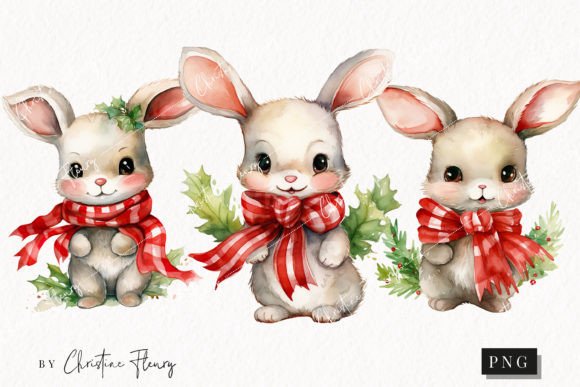
Watercolor Christmas Bunnies Clipart: Designer Review
As a graphic designer who spends the majority of my week refining brand identities and preparing marketing visuals for small business clients, I approach every new graphic design asset with a critical eye. It is not enough for an image to simply be cute; it must be versatile, technically sound, and capable of elevating a commercial project. Recently, I had the opportunity to integrate Watercolor Christmas Bunnies Clipart into a seasonal campaign for a boutique handmade goods client. The goal was to create a cohesive visual language for their holiday product launch, spanning everything from packaging design to social media graphics. Here is my professional assessment of how these illustrations perform in real-world design scenarios.
First Impressions and Visual Mood
The immediate appeal of this collection lies in its soft, organic texture. Unlike vector-based graphics that can sometimes feel rigid or overly digital, these watercolor illustrations possess a genuine hand-painted quality. The edges are soft, the color transitions are subtle, and the overall aesthetic evokes warmth and nostalgia. For a client targeting families, children, or lovers of cottage-core aesthetics, this mood is invaluable. It creates an emotional connection before the viewer even reads the copy. However, from a technical standpoint, the first thing I checked was the resolution and transparency. For professional commercial design, crisp PNG files with clean transparent backgrounds are non-negotiable, and this asset delivers on that front, allowing for seamless integration into complex layouts without unsightly white boxes around the subjects.
Versatility in Client Projects
The true test of any digital product is its adaptability. I tested these bunny illustrations across several mediums to gauge their utility. For packaging design, specifically on kraft paper boxes for handmade soaps and candles, the watercolor style blended beautifully with the natural texture of the material. The soft hues did not clash with the earthy tones of the packaging, creating a harmonious unboxing experience. In terms of print-on-demand applications, such as t-shirt design and tote bags, the illustrations held up well when scaled up, provided the source file was high-resolution. The details in the fur and the festive accessories, like scarves and hats, remained distinct rather than becoming muddy blobs of color.
For digital applications, I incorporated the clipart into social media graphics for Instagram and Pinterest. The whimsical nature of the bunnies increased engagement rates on posts announcing holiday sales. They also worked exceptionally well as decorative accents in email newsletters, breaking up text-heavy sections and guiding the reader’s eye through the content. For those using platforms like Canva, these assets can easily be dropped into pre-made templates, saving hours of design time for small business owners who manage their own marketing visuals.
Strategic Placement and Visual Hierarchy
Understanding where to place these elements is crucial for maintaining visual hierarchy. These illustrations work best as hero graphics or focal points in spacious layouts. I found them particularly effective on invitation cards and printable wall art, where they could occupy significant real estate without competing with dense text. However, designers must be cautious when using them in crowded compositions. Because watercolor textures have inherent complexity, placing them over busy backgrounds or alongside intricate patterns can reduce readability and create visual noise. I recommend using them on clean, light backgrounds or isolating them with ample white space to let the artwork breathe.
In brand identity projects, these bunnies serve better as seasonal accents rather than core logo elements. While they are charming, their detailed nature makes them less suitable for small-scale applications like favicon icons or embroidered logos on caps, where fine details get lost. For such uses, a simplified vector version or a solid silhouette might be more appropriate. However, for sticker designs and labels, the detail is a strength, adding perceived value and craftsmanship to the product.
Technical Considerations for Designers
Before delivering any final files to a client, I run a series of technical checks. First, I test the contrast. Watercolor art often uses pastel palettes, which can disappear on light backgrounds. I always preview the Watercolor Christmas Bunnies Clipart on both white and dark backgrounds to ensure visibility. If necessary, I add a subtle drop shadow or a solid shape behind the illustration to improve legibility. Second, I check the file formats. While PNG is standard for raster images, having access to SVG or vector files would be a bonus for scalability. Since this is primarily a raster-based clipart set, ensuring the DPI is at least 300 for print projects is essential to avoid pixelation.
Typography pairing is another critical aspect. I experimented with various font styles to complement the illustrations. Serif fonts added a classic, storybook feel, while handwritten script fonts enhanced the personal, handmade vibe. Sans serif fonts provided a modern contrast, making the design feel contemporary despite the traditional subject matter. I avoided overly decorative display fonts, as they competed with the intricate details of the bunnies. The key is balance: the text should support the image, not fight it.
Commercial Viability and Licensing
For freelance designers and agency owners, licensing is a paramount concern. Before using any design assets in a client project, I strictly verify the commercial license terms. This collection is marketed towards creators in the creative marketplace, including Etsy sellers and Cricut users. It is vital to confirm whether the license allows for use in physical products, digital downloads, or both. Most reputable clipsarts allow for unlimited commercial use in physical end-products, but restrictions may apply to digital resales or print-on-demand volumes. Always read the specific license agreement included with the download to protect yourself and your client from legal issues.
Furthermore, for those creating Cricut projects or sublimation designs, understanding the limitations of raster images is important. Unlike vector SVGs, these PNGs cannot be infinitely scaled without loss of quality. Therefore, they are ideal for standard-sized prints like mugs, shirts, and posters, but may not be suitable for large-format banner printing unless the original file is exceptionally large.
Final Verdict
In conclusion, Watercolor Christmas Bunnies Clipart is a strong addition to any designer’s toolkit for seasonal projects. It excels in creating a warm, inviting atmosphere for handmade businesses, boutique brands, and family-oriented marketing campaigns. Its strength lies in its emotional appeal and versatility across packaging, social media, and printable products. However, it requires thoughtful placement and technical diligence to ensure it enhances rather than clutters the design. When used correctly, paired with appropriate typography and respected for its technical limits, this asset can significantly elevate the professionalism and charm of a holiday design project. For designers looking to add a touch of whimsical elegance to their winter collections, this illustration set is a reliable and effective choice.